Showing posts with label poet. Show all posts

Sunday, January 19, 2025

Studying Poetry (a poem) by Leanne Dyck

I was introduced to poetry, as many of you were, in grade school. Later, I matriculated and a professor furthered my studying on the subject. Those two experiences were remarkably different. How? Well...


photo by ldyck

 Studying Poetry


The first time I studied poetry
I was encouraged to
think
feel like a poet


I was rewarded with
Well done, Leanne
Insightful


And I felt like
a genius
poetry was part of me


The second time I studied poetry
I was taught that
poetry 
was a bug 
to be 
di-s-sect-ed


I was chastised with
Not that
The poet clearly didn't mean that


And I felt like
a foreigner in a strange land
clearly, I didn't get it


And so now
I've decided
not to study poetry
but simply
to enjoy it


written the morning of 11/18/2024

photo by Byron Dyck


Sunday, January 26
Making Giant Snowballs (children's story)
Making Giant Snowballs encourages children to show acceptance and kindness--especially to people who are different from themselves.

Sunday, April 9, 2017

The Wind by Robert Louis Stevenson reviewed by Leanne Willetts

Robert Louis Stevenson writes with old-fashioned charm. He takes delight in the simple and ordinary. This poem, in particular, views the wind through a child's eyes.

He wonders as to the nature of the wind:  'Are you a beast of field and tree,/or just a stronger child than me?'

The poem has a way of pulling you back to childhood, when you had time to sit and wonder.

The poem draws upon all your senses. You feel the wind push at your face. You hear its windy song. You see it merrily dance with the kites, birds, and grass.

The poem too talks about the sadness of not being able to find the unapproachable. The mystery always seems to be around the next corner:  'I saw the different things you did,/ But always you yourself you hid./ I felt you push, I heard you call,/I could not see yourself at all-'


I wrote this review on September 15, 1987, for a children's literature class I took at the University of Winnipeg.


I saw you toss the kites on high
And blow the birds about the sky,
And all around I heard you pass,
Like ladies' skirts across the grass--
O wind, a-blowing all day long,
O wind, that sings so loud a song!

I saw the different things you did,
But always you yourself you hid.
I felt you push, I heard you call,
I could not see yourself at all--
O wind, a-blowing all day long,
O wind, that sings so loud a song

O you that are so strong and cold,
O blower, are you young or old?
Are you a beast of field and tree,
Or just a stronger child than me?
O wind, a-blowing all day long,
O wind, that sings so loud a song


Next post:  Sunday, April 16 (5 PM PT) 
Her Words (short story)


(click on image to embolden)

"I have a story to tell"

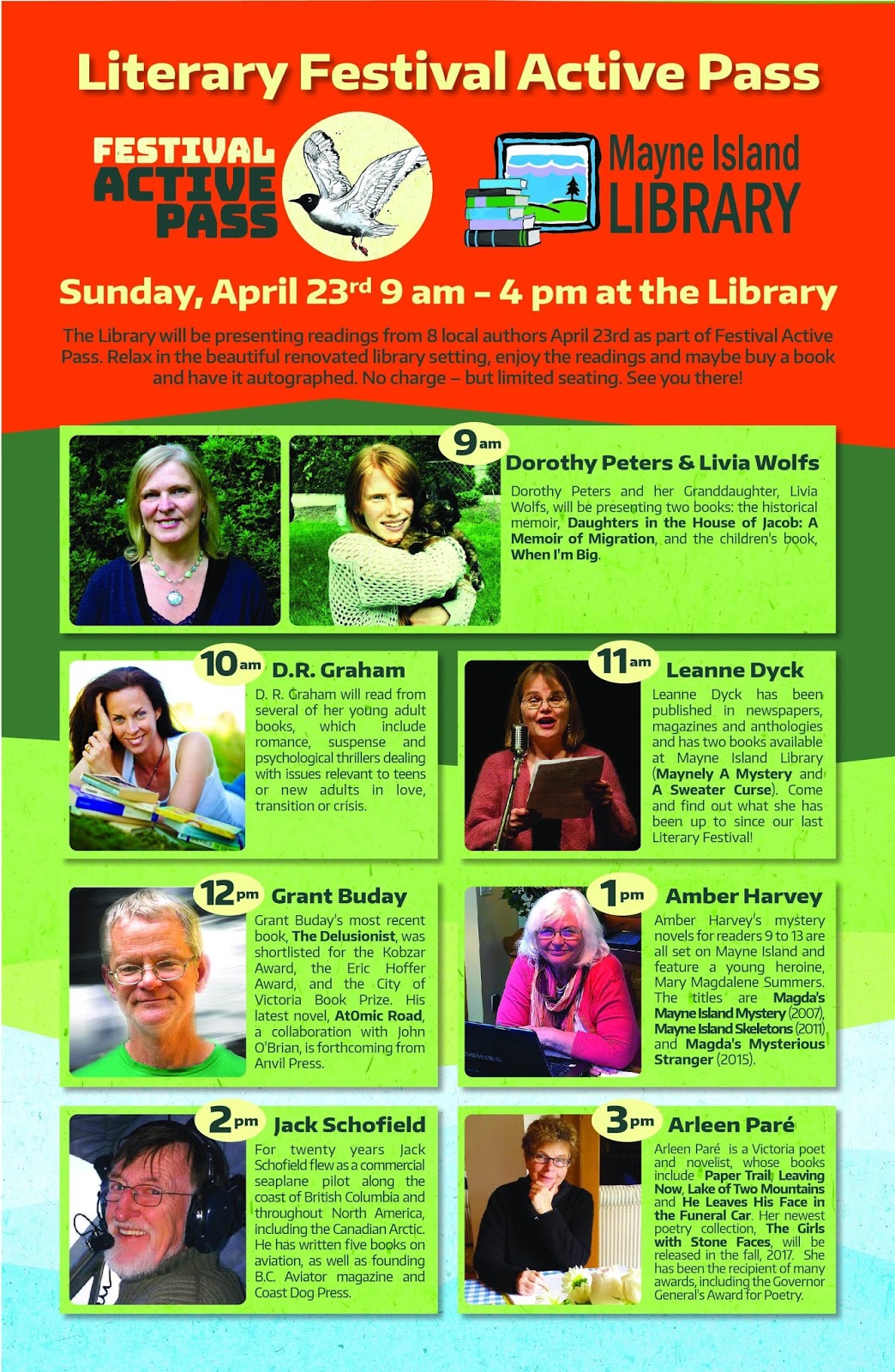
Leanne Dyck's Author Reading
Sunday, April 23rd 11 am
Mayne Island library
Festival Active Pass

"Looking forward to seeing you there."

Thursday, November 21, 2013

Guest Post: Poet David Fraser

How/why did you start to write?

My earliest memory of writing was before I really had a grasp of the alphabet. I recall writing on the backs of discarded envelopes and composing my own stories about Peter Pan and the Cisco Kid. The writing was mere scribbles. Later in middle school I began writing poetry. Unfortunately in grade seven a teacher accused me of handing in a poem that my mother had written. I should have taken this as a complement but rather closed myself off after such an accusation. During high school I was writing all the time but keeping it to myself, as well as reading everything I could that interested me.

 I was fortunate to have two mentors in university, one was Margaret Avison, who twice won Canada's Governor General's Award and has also won its Griffin Poetry Prize.  The other was Margaret Aitkin. During that time both these mentors opened up their offices for informal discussions and the writing of poetry.  Also I was encouraged to publish my work and a number of poems were published in the University of Toronto anthology publications.

 Why I started to write is a mystery. Probably I can saw it was a means of exploring possibilities.


How did you become an author?

I would say as soon as I started writing, I considered myself an author. During my university years I was published and that made me feel I was a writer. However I pursued a career in teaching at the secondary and senior school levels, and although I continued to write, I had little time to pursue an active marketing campaign to publish a lot of my work. Nearer the end of my teaching career, I began publishing my work and for the last 18 years I have been published in many on-line and print journals as well as anthologies and my own collections.

What was your first published piece?

Probably the first published poem is “If”. It is a love poem to my first wife. Miraculously enough it was the first poem that I received a royalty cheque, ( $5.00 in 1979) since a Toronto composer used a few lines of my poem along with lines by Irving Layton for lyrics in a performed composition called Ex Tenebris.

Where was it published?

“If” was published in in complete by C.E. University of Toronto

How long ago?

1970

What did you do before embarking on your writing career? Was it an asset to your writing? How?

As I mentioned my main career was in education, where I taught primarily English, English Literature and Creative Writing. Obviously the content and the process of teaching others to write and work with text kept me always in a mode close to the written word. However I have worked as a baker, bartender, waiter, factory worker, ski instructor, and travelled. All of these experiences provide the raw material for my writing. Basically I see myself mining the sediment of my life, the newly deposited particles of current every day and also the deep layers that have been laid down over time.

What inspires you?

Life inspires me. I live in a location that is remote from large cities. I can walk outside my door, take the dogs for a run in the bush, go down to the sea, stare up at the mountains that sit across the strait to the mainland or look at the peaks of the mountains that from the ridge that runs the length of Vancouver Island. I am always active, whether it is writing, gardening, hiking and playing sports. People inspire me and I with my small publishing company and with the spoken word event, WordStorm, that I co-founded and run monthly out of Nanimo, I feel I am paying it forward, giving aspiring and established writers an opportunity to share their work either on the page, the computer screen or on the stage. That’s what inspires me.

Please share one of your successful author platform building technique

I am currently working on a crime noir novel and will either self-publish or use a traditional trade publisher to present my book to the world. That will be a different experience than marketing poetry, since poetry is such a small segment of what people read these days. In terms of poetry, I believe, the live performance, either as a reading from a collection or as a spoken word, no paper, presentation is the best and most entertaining way to market my art. I enjoy the live audience. That is where you connect your words to individuals. Otherwise, it is also a good idea to have a web site, possibly a blog if you have the time and regiment to do so. Joining writers organizations is also a good idea. I belong to the Federation of BC Writers and in the past have served as a Rep for the Vancouver Island Region. I also belong to the League of Canadian Poets and receive funding for readings through being a member. I find that the more I do to help others, the more comes back to me in terms of author platform building.

Parting words

My writing comes from a process of accumulating sediment. Experience, imagination, truth and lies are laid down over time in layers and these layers are compressed by the weight of living. These are the strata that I mine to hone my craft.

Each moment in a day inspires me. However it is so hard to stay in the moment when the past, with its boxes of overlapping memory, beckons me to mine the sediment of my life, and of course when the future teases me with expectation and prediction. I find true joy when I can smash the moment, and be attentive to what is happening. It is then that I am a witness and an inspired observer on this fleeting journey. Perhaps it is then that a small round pebble on a beach will catch my eye and I will roll it along the tips of my fingers in meditative silence, before I stow it away in the depths of a pocket.


Links


David Fraser

Writer, Poet, Spoken Word Performer, Publisher, Editor

David Fraser lives in Nanoose Bay, on Vancouver Island. He is the founder and editor of Ascent Aspirations Magazine, www.ascentaspirations.ca since 1997. His poetry and short fiction have appeared in many journals and anthologies, including Rocksalt, An Anthology of Contemporary BC Poetry. He has published five collections of poetry; Going to the Well, 2004, Running Down the Wind, 2007, No Way Easy, 2010, Caught in My Throat, 2011 and, Paper Boats, 2012 and a collection of short fiction, Dark Side of the Billboard, 2006. In addition David has co-authored with Naomi Beth Wakan, On Poetry an inspirational book on poetics and poetry. To keep out of trouble he helps develop Nanaimo's spoken-word series, WordStorm. www.wordstorm.ca. In October 2009 and 2010 he participated in Random Acts of Poetry, a national poetry program that brings poetry to the streets of Canada. David is a full member of the League of Canadian Poets and is available for performances and readings via funding with LCP.

Friday, September 27, 2013

Writers' Circle (poem) by Amber Harvey

Writers’ Circle
by Amber Harvey

Papers, notebooks, laptops
Cast nets
To capture thoughts
            that swim
            in the rivers of our souls
But not all.

Our souls’ divers spiral downward
            into a maelstrom
Where image, feeling, story,
            like cells in primeval mud
Attire themselves in life
            and become language
Then all spiral upward
            through a vortex
            where meaning
            is caught and held
Letters form words
Words form phrases
To wrap and hold the meaning
            in booklets, pages and laptops

Beyond the bounds
            of books, papers and laptops,
Swim the thoughts
            that can’t be captured.


Thursday, July 12, 2012

To Any Reader by Robert Louis Stevenson reviewed by Leanne Willetts

To Any Reader
by Robert Louis Stevenson

As from the house your mother sees
You playing round the garden trees,
So you may see, if you will look
Through the windows of this book,
Another child, far, far, away,
And in another garden, play.
But do not think you can at all,
By knocking on window, call
That child to hear you. He intent
Is all on his play-business bent.
He does not hear; he will not look,
Nor yet be lured out of his book.
For, long ago, the truth to say,
He has grown up and gone away,
And it is but a child of air
That lingers in the garden there.

I wrote this review on September 24, 1987, for a children's literature course at the University of Winnipeg. The professor, whose name has unfortunately been lost to history, awarded me an A- and commented, "Interesting, as always." I will include her other comments at the end of this post.

I have resisted the desire to rewrite—and will quote the entire review as it appeared when submitted, long ago.

(me in the 80's)

Stevenson's talent as a poet seems to be his ability to write from a child's point of view. This talent may stem from a chance lost, this chance being his ability to enjoy a healthy childhood.

Stevenson captures this sad longing in the poem To Any Reader.

The line, 'a child of air' seems to me to be expressing the idea of further strengthened by these lines, 'For, long ago, the truth to say,/ He has grown up and gone away.'

Stevenson has, in fact, found in his poems a safe place for his memories to remain. Writing may, in fact, act as a type of therapy to release him of the sad longing for a chance lost.

Most children, if read this poem, would, of course, not be impressed by Stevenson's sad longing. The poem holds for children the possibility of making a new friend, the new friend being the 'child of air' or, in fact, poetry.

The professor's additional comments...
Nice observation. The adult nostalgia for childhood can be seen over and over again in children's literature. It might, in fact, be an interesting topic for a critical article. If you're interested, I could start you on some books.

My reply (too many years later--I fear)
Yes, I am interested. Please direct me to them.


Sharing my author journey... 

I tried to force one of my characters to react in a way that made 

Friday, June 15, 2012

Guest Post? Author Sandi Johnson


I thought I was born to write. Considering the hurdles and 
delays, the challenges in finding time to write, I’ve 
sometimes wondered if it’s in this lifetime. Given a three
hundred year life expectancy, I might be brilliant and 
prolific.

I first published with the Winnipeg Free Press. In the early
1970s I was taking a course in magazine article writing at 
the University of Manitoba. The course instructor Chris Ladd
gave me the opportunity to write a full page column titled 
“Art and Artists” in which I interviewed the major Manitoba
artists for the Saturday Leisure section of the newspaper. 
In approaching the interviews, I intuitively understood that
I had to find the creative centre of the artist and write 
from there.

For me, art is a way of making order in the world. I write 
in several genres, poetry, drama and fiction. I also review
books, the arts and entertainment. The centre of the work
is its meaning. That seed provides the themes which are the
grid for the writing.


Published by Beach Holme in 1992, “The Comfort of Angels” 
is a fictional work based on my experience of working in a 
managerial capacity with Ojibwa Indians in northwestern 
Ontario. Set in an Indian Friendship Centre, the book is about 
the least, the last and the lost. The book itself asked to be 
written. I had other plans, an easier book. It’s about people 
who are hurting and it was painful to write.

A big challenge for me is how to handle my material. I wrote
“The Comfort of Angels” in prose poetry to express the spirit
of people struggling to endure. The underlying rhythm is the 
sound of the human heartbeat, or the drum, the pivotal symbol
of the culture. 

Writing is about discovery and learning. Reading’s an 
essential component of that learning. It’s a meditative 
process where I’m asking who, what, where, when, why, how, 
and in the case of  “The Comfort of Angels”, why me? 


Published by Beach Holme in 1994, “The Wonderful 
Naked Man” is a book of poetry and line drawings. 
I wanted to learn to use my imagination. The wonderful
naked man, a luminescent, purposeful champion of the
everyday possibilities in life, is fighting in the war against
inhibitions. The book quickly entered a second printing. 
It was produced with great success by Active P.A.S.S. 
Theatre, Salt Spring Island, B.C.

I’ve most recently completed “People Like Us”, a script for 
theatre. Commissioned by social activist Maggie Schubart of
 Peace Works!, Salt Spring Island, it’s the story of a Canadian 
military policeman’s return from the 1991 Gulf War. This was 
very difficult material to handle; the research was gruesome. 
It is ultimately about the human qualities that help the couple
endure as they lose everything that matters to them.

After working in the health care sector for more than a decade, 
I’m just beginning to market my writing again. I retired from 
Home Care in May 2010 and concluded my work as a medical 
office assistant in November 2011.

I think clear communication with potential readers is essential 
to marketing. To assist me in marketing I recently attended a 
seminar, ”How to be Your Own Publicist”, sponsored by 
The Writers’ Union of Canada. I’m also a member of the 
Playwrights Theatre Centre, Vancouver.

I’m interested in imaginary work that’s socially relevant. 
Ultimately the expression isn’t about the self; it’s much bigger
than the self. It’s an act of inquiry with the Mystery. It comes 
from my guts, but it’s really about the universe.

                                                                                                                                             Sandi Johnson


Friday, May 4, 2012

Guest Post Poet, Author Daisy Hickman

Published author and poet, M.S., Iowa State University (sociology), founder: SunnyRoomStudio
Winds of Time
Words are vehicles for understanding.  Like all artistic forms, they offer avenues of expression that are varied and dynamic.  From poetry to prose, from blogs to novels, words are links between individuals, family systems, organizations, and countries.  I’ve been drawn to them for a lifetime it seems.
Lately, though, poetry is getting much of my attention.  Even a few beautiful lines can nearly stop one’s breath with its perfection: its urgency. 
In addition to my work in SunnyRoomStudio, a creative, sunny space for kindred spirits launched in early 2010, I enjoy writing and editing poetry each day.  Maybe only for a few moments, but maybe for a few hours.  I trust my intuition in this regard.
I listen closely for the ideas, the observations, the feelings, that are edging their way into my awareness.  Silence is the great conductor when it comes to writing poetry.   
Beauty is also something that inspires a great deal of poetry.  By nurturing our souls, beauty inspires us to address the mysteries of the cosmos.  Nature.  Artwork.  A beautiful spring sky.  The smallest bud on a birch tree or a rose bush can lead the way.
The gentle winds of time have guided my interests and goals as a writer.  Always fluctuating.  Always open to that creative stirring – to that moment when an intriguing idea grabs me unexpectedly. 
You can find more of my work in SunnyRoomStudio—poetry pages, blog, book information from ’99—and even some of my quotes – kindred spirit quotes.  But for my guest post, I’d love to leave you with a poem I wrote this morning. 
“Only a Light”
Nothing catches my eye like a hint of dawn,
that ribbon of pinkish-white
against a landscape of reassuring blue, 
yet, swiftly, it’s high noon, then evening,
and the deep black of nightfall, and
I sense I’m moving with the light,
letting it carry me along, letting it point the way,
a laser of ever-changing shades,
a bouquet of color. 

~ D.A. Hickman, May, 2012

Thanks, Leanne, for the kind invitation to share a few thoughts on your blog. 

Links
http://sunnyroomstudio.com/
Twitter:  @DazyDayWriter & @DHwrites
Facebook:  SunnyRoomStudio

Tuesday, April 3, 2012

Meet Pauline Johnson (3/ 3) by Leanne Dyck


I was digging through my filing cabinet hunting down something else and came across something. This something is an essay I wrote in November 1996 for a university course I was taking. Here's hoping you enjoy it. (FYI, I resisted the urge to re-write.)

First installment
http://sweatercursed.blogspot.ca/2012/03/writing-meet-pauline-johnson.html#links

Second installment
http://sweatercursed.blogspot.ca/2012/03/writing-meet-pauline-johnson_27.html#links

Third and final installment...

Through her entire career she did not stray from her goal. She firmly believed that ‘White race and Red are one if they are Canadian Born.’ (Betty Keller, p. 197) Her own performances were a fine balance between two worlds. She wore a native costume and recited her unconventional native poems during the first part of her performance. She wore a ball gown and recited traditional poetry during the second part. It always remained clear in Pauline’s heart who she was. Upon overhearing… "She's just like a white woman.” Pauline snapped angrily, “Is that intended as a compliment?" ‘ (Grant MacEwen, p. 68) Pauline was very proud of her legal Mohawk status.

A much more appreciated compliment came from ‘a soldier who had fought in the North-West Rebellion... Deeply moved by ‘A Cry from an Indian Wife,' he said, “When I heard you recite that poem, I never felt so ashamed in my life of the part I took in it!” ‘ (Betty Keller, p. 60) A quote from Pauline’s poem ‘The Cattle-Thiefs’

‘What have you left to us of land, what have you left of game
What have you brought but evil, and curses since you came?
How have you paid us for our game? How paid us for our land?
By a book, to save our souls from the sins you brought in your own hand.’
(Margaret Harry, p. 150)

Pauline did not shy away from using her poetry to express what was in her heart. ‘She could and did bring protest and unmistakable anger to verses in which she spoke for her fellow natives… She reminded those of the invading race of their aggressions.’ (Grant MacEwen, p. 72) Yet she marketed her message in a package that attracted her target white audience. This was Pauline’s true genius. It is worth noting that, ‘the resentment against imposed stereotypes and the suffering resulting from a disrupted way of life which Johnson’s work expresses remain central themes in Canadian literature today.’ (Margaret Harry, p. 152)

Until her death on March 7, 1913, Pauline educated white audiences on the wisdom of the native ways. In 1910 she began to employ techniques to conserve her energy. Eileen Maquire appeared with her since there was little hope of Pauline carrying a full program… (She read) her prose selections, especially the Capilano legends, instead of reciting poetry. On other occasions, she gave ‘informal talks’ on the legends and traditions of the Mohawk people.’ (Marcus Van Steen, p. 253)She remained committed to her goal of achieving unity among whites and Indigenous until the very end.

Bibliography


Gorham Harriet “Johnson, Emily Pauline” In The Canadian Encyclopaedia Volume 2, 1988 Hurting Publishers Ltd., Edmonton

Harry, Margaret “Literature in English by Native Canadian (Indian and Inuit)” In Studies In Canadian Literature Volume 10, Numbers 1-2 1985 University of New Brunswick, New Brunswick

Keller, Betty Pauline:  A Biography of Pauline Johnson 1981 Douglas & McIntyre, Vancouver

MacEwen, Grant “Pauline Johnson:  Princess” In ...And Mighty Women Too:  Stories of Notable Western Canadian Women 1976 Western Producer Prairie Books, Saskatoon

Van Steen, Marcus Pauline Johnson:  Her Life and Work 1973 Compton Printing Limited, London

Willoughby, Brenda Pauline Johnson Canadian Pathfinders Series Groiler Limited, Toronto

Tuesday, March 27, 2012

Meet Pauline Johnson (2/3) by Leanne Dyck


I was digging through my filing cabinet hunting down something else and came across something. This something is an essay I wrote in November 1996 for a university course I was taking. Here's hoping you enjoy it. (FYI, I resisted the urge to re-write.)

I offered the first part of this three-part post last Tuesday. You can find it here.

Today I'll offer the second part...

Pauline accomplished much in her career. She wrote scores of articles, poems, and prose for children and adults. She also wrote six books:  White Wampum, Canadian Born, Legends of Vancouver, Flint and Feather, The Shagganappi, and Moccasin Maker.

White Wampum was published in 1895 after her successful tour of England. "Those were the days of the drawing-room entertainment, and Pauline was in great demand throughout the season of 1894.' (Marcus Van Steen, p. 22- 23) 'London...spontaneously...accepted her as both the cultivated lady and the princess from the primeval forests." (Betty Keller, p. 106)

Canadian Born was published in 1903. 'This book contains poems that show Pauline's pride in her native land. Her eight years on the roads and railways of Canada had increased her love of her country.' (Brenda Willoughby, p. 34). She brought her unique entertainment to remote communities. She helped to build a unified Canada from a country separated by geography.

Legends of Vancouver was published in 1911. Critics proclaim it to be one of Pauline's most important works. The book was based on the legends of the Capilano nation of British Columbia. Pauline had befriended Chief Capilano in 1906. He and a small party of chiefs had travelled to England when Pauline was making her second tour. The chiefs arrived in England determined to discuss their people's plight with the King and Queen. Pauline and Chief Capilano formed a friendship that would last until he died in 1910. 'She heard from his own lips some of the ancient legends of his people, which she started writing down... This was the first attempt to record tribal mythology of the Pacific Coast Indians.' (Marcus Van Steen, p. 32)) True to native oral traditions Pauline embellished the legends.

Flint and Feather was published in 1912. Shortly after its publication, Pauline died of cancer. Flint and Feather was falsely labelled as 'the complete poems of E. Pauline Johnson.' Pauline had long since retired from the stage. She was tired and took up residence in Vancouver, BC. However, her fans' demand for another book was great. The task of making the selections for the book fell to the ladies of the I.O.D.E.

The Shagganappi and Moccasin Maker were published in 1913 posthumously. The books were a loving tribute. The Ladies of the Press Club compiled a series of articles. The Shagganappi 'was composed of the boy's stories that (Pauline had) submitted to The Boys' World.' (Betty Keller, p. 260) Moccasin Maker was composed of 'stories that had been submitted to Mother's Magazine and included her four-part story, 'My Mother'.' (Betty Keller, p. 260)