Showing posts with label publisher. Show all posts

Sunday, January 14, 2018

My Writing Strategy for 2018

"Beyond the Fog" ldyck

I write in many different genres. To date, I've written...


37 picture books for children
1 YA novel
6 short story collections for adults (includes a composite  novel)

My goal is to break into traditional publishing. (I began my career as an indie author. And was also published by a small press.)

Picture books are reported to be hard to break into and this has held true for me. So in 2018, they will take a back seat to my other work. This doesn't mean I will stop writing them--never shut the door on inspiration. They simply won't be my focus.

You may know that I've been writing a middle grade novel (for children ages 9 to 12 years of age). This one of the first times I've attempted to write for this age group. (The second time was a short story that has potential to become something longer. Here's the link to read that story.) I will continue to work on this novel. Three short novels for adults round out my work for 2018.

This is my strategy for the new year. But my strategies like my plot lines are flexible--I remain open to inspiration and direction (provided by educated/experienced outside sources). 


"Hey, look over there" ldyck


Sharing my author journey...

Sunday, March 12, 2017

How to get an unsolicited manuscript read

 Some authors are fortunate to have the assistance of a literary agent. But I'd wager that the majority of us don't. So we are left to navigate the publishing industry labyrinth by ourselves.

rock art by my husband, photo by me

Since I started keeping careful records, in 2014, I've sent 400 submissions to publishing houses. Over the years, I learned some valuable lessons. One of the most important was how to properly address a cover letter. 

Dear Sir or Madam
or 
To Whom It May Concern


This is the equivalent of standing on the street corner, waving your arms in the air and shouting, "Hey, you!"
Someone may hear you. But the chance that she will be the right person are slim.

Dear Publisher
or
Dear Editor


Visit the publishing house website and carefully study the submission guidelines. (Some submission guidelines give you all the information you require. Others don't.)

Small publishing houses may tell you to send your submission to the publisher. All publishing houses have at least one editor. So there is a chance that your submission will get to a publisher or an editor. But there's no guarantee that it will get to the right publisher or editor. Moreover, addressing your submission in this manner shows that you didn't do your homework and that you may not even know who the right publisher or editor is.

How do you find the name of the right publisher or editor?

Roll up your sleeves and click those computer keys. You want to find not only the contact's job title but also her name
'If [the publishing house] has multiple editors, approach an assitant editor, associate editor, or senior editor (Generally avoid managing editors, who oversee the daily operations but often don't read unsolicited manuscripts)' -How to stay out of the slush pile

Other reference sources...

-books in your genre -- read the acknowledgment section. Sometimes authors will thank their editors. 

-join genre associations or genre specific writing groups -- members may be able to supply you with the name and job title

Dear Kathlene Witherspoon, Assistant Editor


"Bim" photo by ldyck
Next Post:  March 19 at approximately 5 PM PT 
Book review:  Note to Self by Laurie Buchanan (self-help) 

Friday, October 31, 2014

Guest Post: Ronsdale Press

Thanks to Leanne for giving us the opportunity to post on her blog!

(It's my pleasure. I'm looking forward to learning more about Ronsdale Press.)

Ronsdale Press was founded in 1988. We are a literary publishing house that publishes fiction, poetry, regional history, biography and autobiography, and books for young readers.


-This is a challenging time to be a publisher. How is Ronsdale Press uniquely equipped to meet these challenges?

It’s a challenging time, but also an exciting time. The expansion of ebooks and online vendors is certainly changing the publishing landscape, and it’s interesting to be a part of it all. I think that mindset—that we are eager to find ways to not just “cope” but to excel in this new era of publishing—is essential.
We publish almost all our new books in ebook format, stay active on social medial and embrace sites like 49th Shelf, All Lit Up, and Goodreads. Our staff routinely takes part in professional development seminars to further our education in these areas. We are also in the process of working with a print on demand company to more efficiently print and ship our titles to customers abroad.
And while the medium may be shifting, the content largely remains the same—and readers want good content. Publishing prominent writers like Jack Hodgins, and award-winners like Pamela Porter and Richard Wagamese, is a giant first step in meeting these challenges.

-I understand that Ronsdale press is a Canadian publisher, what unique benefits and challenges do this present?

An obvious challenge is that many great Canadian writers don’t receive the same “buzz” that an American author might, limiting our exposure to the casual reader. But that just means we have to work a little harder promoting our authors, and groups like the Literary Press Group and others are making progress on that front.
An enormous benefit is the wealth of amazing writers here in Canada. We’ve published a great many non-fiction books and biographies, too, which would not be possible without Canada’s fascinating stories and story makers. 
-How does Ronsdale Press market its books? Does it have a global reach?

Essentially, with the internet and technology of today, we have achieved global reach. While we focus our marketing efforts in North America and the United Kingdom, we do provide direct sales to customers from anywhere (anywhere we can ship to, that is). A few recent examples include India, South Africa and Korea. Printing on-demand in foreign countries will greatly help this effort.
  
-How do you market your books?

We advertise in both local and national media, and send review copies to reviewers across Canada and the United States (and sometimes abroad). We are active on Facebook, Twitter, Pinterest and our own website, as well as with our monthly newsletter. Ronsdale and our authors participate in book launches, fairs, festivals, signings and readings.
-Please describe a typical workday at Ronsdale Press.

Like many independent publishers in Canada today, we have a small office with a limited staff. A “Publishing Assistant” in today’s industry wears many hats: secretary, marketing co-ordinator, copy editor, publicity manager, head of the shipping department, and many more.

-Do you publish print, ebooks or both?

We publish both print copies and ebooks of almost all our new titles. We have also converted a great many of our backlist titles to ebook format and continue to do so.


-Please lead us through Ronsdale Press's author submission process...

We accept manuscripts from Canadian writers, both emerging and established, as per our submission guidelines. We review all manuscripts that arrive and strive to reply within 2-3 months. Our readers review the submissions and make their recommendations to the acquisitions editor, who makes the final decision. We will then reply to the author with our decision and include any relevant feedback regarding their work.

-How do you choose the authors you publish?

First and foremost, the manuscript must good fit for Ronsdale and one that we can promote successfully. We need the author to be able to promote their own work, too. As the face of Canada changes, we are increasingly looking out for multicultural writers. And as our mandate states, we are “dedicated to publishing books from across Canada, books that give Canadians new insights into themselves and their country.”


-Please walk us through the process of publishing a book...

After accepting a manuscript, we work with the author to edit their book to a publishable standard. Our designer creates for us a cover and bookmark for the title. When editing is complete, we send it to the typesetter. We proofread the typeset copy very carefully at least once more before sending it to the printer. Meanwhile, early promotion is underway and we communicate with our sales reps about how many copies we should print. The book is then printed and distributed to the bookstores, where we hope they sell, sell, sell!

Friday, October 24, 2014

Guest Post: Little Fiction

  1. What is Little Fiction's mandate?
I never really thought of us having a mandate, but our reason for being is to give indie / up-and-coming writers another vehicle for their work and to introduce our readers (who are also mostly writers) to some new works and new talents. Since we started, we've seen a handful of our authors land book deals and release debut collections that their LF stories have been a part of, and that's really the end goal for now. I don't know if that constitutes a mandate, but it's something we're damn proud of.


  1. How/why did you decide to be a publisher?
I was trying to get some work published years ago (surprise, I'm also a writer) and the best advice I received was to do it myself. So I started an indie label called Instrumental Press. I published one title (mine) but struggled to get good distribution. And money. Many years later, technology allowed me to try again and Little Fiction is the result.

  1. When was Little Fiction established?
As an idea, it was mid-2010, but the official launch was October 2011.

  1. Share some of Little Fiction's challenges and victories…
Every new title is a victory. Every new author, every returning author. Every twitter follower, every retweet and every download / read of a story. Those are the victories and they'll never stop being the victories. It’s amazing that we have a few thousand people keeping up with the site regularly, but it’s just as amazing that even one person cares about what we’re doing. That’s something I think every writer, publisher, blogger — anyone looking for an audience, really — should never lose sight of.

On a more specific note, getting stories from Shawn Syms, Andrew F. Sullivan and Leesa Cross-Smith very early on was huge. All three have since landed deals for debut collections.

As for the challenges, keeping up with submissions is tough, trying to establish ourselves enough so that our writers can start to win awards for their LF stories has been a little challenging. Finding a model that allows us to pay writers is an ongoing exploration / challenge.

  1. This is a challenging time to be a publisher. How is Little Fiction uniquely equipped to meet these challenges?
Being digital only helps. It keeps overhead low. Not relying on grants that could disappear one year after the next helps. Likewise not worrying about investors / outside sources for funding. We're just kind of doing our own thing, but I don't think that makes us uniquely equipped — there are plenty of awesome indie journals and publishers who can claim the same thing.

  1. What do you see as the benefits of being a publisher?
It's a labour of love, so you have to be into what you're doing, and that's the benefit for me — getting to do something that I love to do.

  1. What genres do you publish?
We don't really get into genre — it's just literary fiction, for lack of a better term. And literary non-fiction, I guess, for our essay / memoir / creative non-fiction label, Big Truths.

  1. I understand that Little Fiction is solely an epublisher. Do you have future plans of establishing a print imprint? Why or why not?
No concrete plans at the moment, but we would at least love to do a print anthology. The bigger idea is to find the right model that would allow us to maintain a print component, and not just do it once in a while.

  1. Who pays the publishing costs--the author or Little Fiction?
We do.

  1. Do you work with literary agents?
We haven't yet, but we're not completely against it. What I like about what we have going so far is the opportunity to build relationships with so many talented and awesome writers.

  1. Does Little Fiction pay royalties and advances?
No, we don't. But we don't charge for our stories either — everything is available for free. If that ever changes we will definitely be sharing any profits.

  1. Please lead us through Little Fiction's author submission process…
It's an open / rolling submission, so writers are free to send stuff whenever (but only one story at a time, please). When we accept a piece, we'll work with the author on edits and a cover design leading up to the pub date.


  1. How do you choose the authors you publish?
Just from reading submissions. We haven't done much soliciting of work yet — because we don't pay it doesn't feel totally right to ask someone for work. But we have reached out to a few writers we love — we did that when we launched Big Truths last year with stories from Angela Palm, Liz Windhorst Harmer, Jessica Nelson and Ayelet Tsabari.

  1. Please walk us through the process of publishing a book…
It's pretty simple. We like to work closely with our writers on edits and we seek their input on cover ideas (within our design aesthetic). We format the ePub files and then send some digital proofs for the authors to check out. After that we're good to go.


  1. How do you market your books?
Social media. Twitter is the biggest one for us, but we also have Facebook, tumblr and Pinterest. accounts. We have a newsletter that goes out monthly when new stories are released, and we've been fortunate to have some of our stories recorded (which you can find on SoundCloud) by the amazing Xe Sands, so there are plenty of channels being used right now for marketing our stuff. We're looking into doing some merch as well (currently we have desktop wallpapers available on the site — people seem to dig them).


Website: Little Fiction


Friday, April 25, 2014

Guest Post: Cozy Cat Press Publishes Light Mysteries for Niche Market

Cozy Cat Press began business in 2010 with publication of its first two cozy mysteries––founder and publisher Patricia Rockwell’s “Sounds of Murder” and Diane Morlan’s “Too Dead to Dance.”  The small independent publishing company, is located in Aurora, Illinois, a Chicago suburb.  

Cozy Cat Press is devoted to the publication of “cozies” or light mysteries that focus more on characters and plot than on graphic violence or explicit sex.  The “cozy” has a long tradition, starting with Agatha Christie’s Miss Marple character, and continuing to the present-day with the television series “Murder She Wrote” starring Angela Lansbury.  Modern cozy fans are typically more interested in reading about amateur detectives and their exploits in solving crimes in their communities.  The genre has become quite popular recently with cozy mystery heroines (most cozy main characters are female) coming from the ranks of school teachers, librarians, shopkeepers, seamstresses, caterers, nurses, babysitters, hairdressers, and various other careers.  Cozies are generally filled with humor, romance, and lots of local color. 

At present, the company has over thirty authors from the United States and Canada in its catalogue with over fifty books published in total. 


Authors (veteran or novice) who are interested in submitting their work to Cozy Cat Press and readers interested in learning about Cozy Cat Press books, can check out the website at:  www.cozycatpress.com.

Here's a sampling from Cozy Cat Press' catalogue...


"Hollywood is in trouble and only one man can save it!

Obsessed actor Joshua Mclintock is not on the "A" list--his last role was playing bad breath in a mouthwash commercial. Assisting him as he struggles to the top is his agent, Robert Bigalow (aka, Biggie), who keeps him busy running to auditions.  Although he’s appeared in numerous films and stage productions, most of Joshua's roles have been dead bodies. But his attitude is unfailingly positive and he knows his big break is just around the corner. His life takes a strange turn, however, when he becomes the prime suspect in a murder case. Of course, any normal person would rush to clear his name. And Joshua would do just that if it weren’t for the fact that an audition beckons. Besides, he believes he can straighten out the misunderstanding by tracking down the real killer, himself.  As his investigation gets a little too close to the truth, his ex wife Randy is captured by a secret organization, and Joshua realizes that there are some things more important than career. He attempts to rescue her, not knowing the deadly consequences awaiting him and the rest of the world's actors.
Will Joshua be able to save his one true-love, Randy? Will he be remembered as the actor who played dead bodies, only to turn up dead himself?
Can he save Hollywood!"


 Retired librarian Carolina Pennsbury is quite content living in a retirement home.   She just wishes that her meal time tablemates felt as she did.  However, all seem to have their own complaints.  But those complaints are put on the back burner when one of the retirement home’s residents is stabbed to death in her apartment and the police arrest one of Carolina’s tablemates, Margie, for the murder.  Carolina, knowing her friend cannot possibly have committed such a deed, sets about to prove Margie’s innocence––a difficult feat for an elderly woman with a cane.  Knowing the real killer is probably still roaming the halls, Carolina uses her wits and her wit to investigate, and ultimately––after a fake fire alarm and a lengthy blackout––manages to ferret out the killer.  But clearing Margie and getting her out of jail is not the end of Carolina’s tasks.  She has work to do for all of her tablemates and she won’t quit until they are all happy.


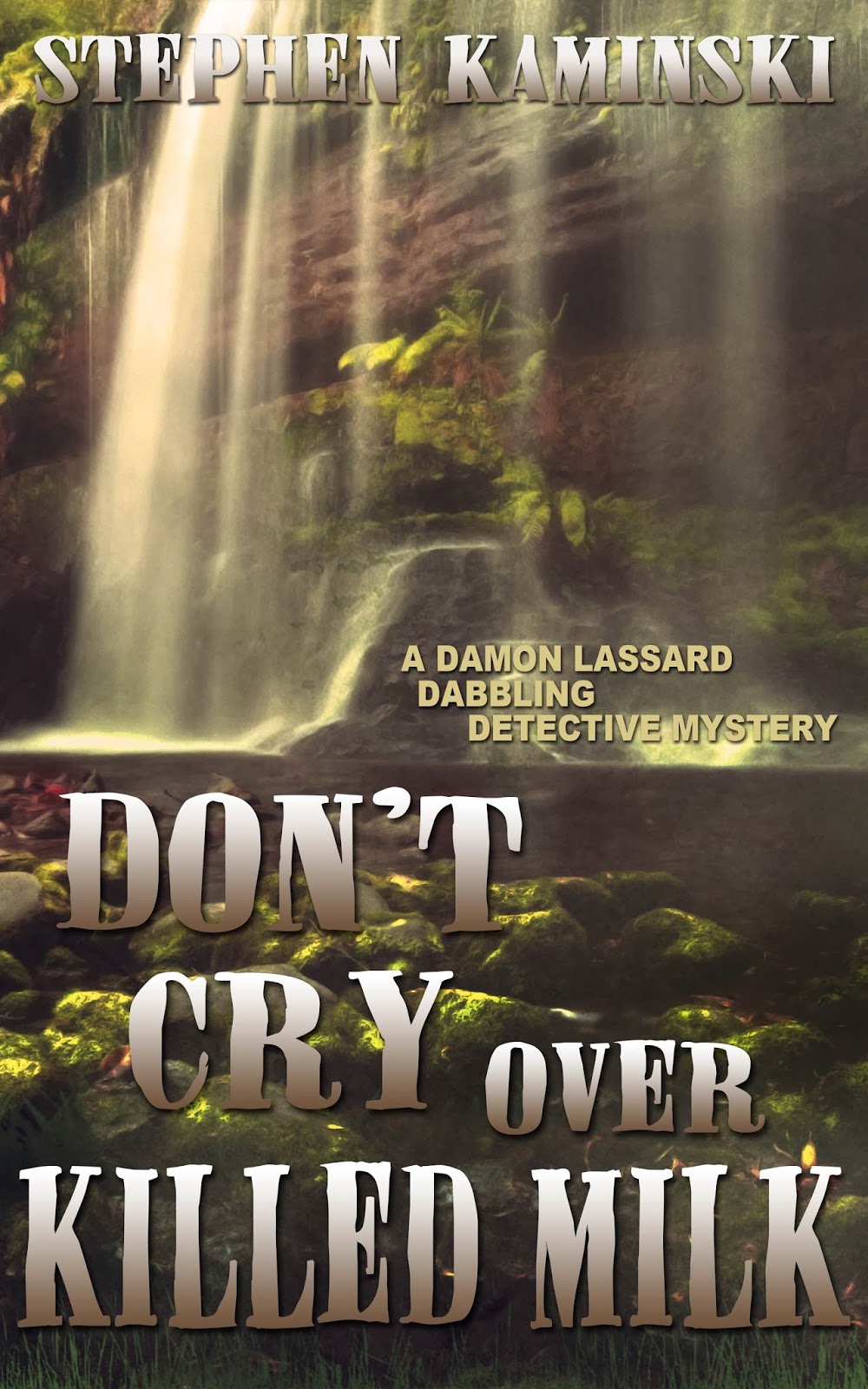
Jeremiah Milk lived a life filled with emotional extremes. Amniotic band syndrome—a congenital condition—left his fingers and toes malformed. Ridiculed as a child, he became an adolescent hermit. As an adult, Jeremiah’s wounds healed when he landed a position as a park ranger and married a woman who loved him despite his physical appearance. But fate ripped his life to shreds when his wife and infant son died on the same night in separate calamities. Shortly thereafter, the tides turned once more as an act of Jeremiah’s ostensible benevolence translates into a financial boon. The book on Jeremiah’s life closes without mercy when he’s found murdered at Tripping Falls State Park.

Damon Lassard—Hollydale’s loveable civic leader, amateur sleuth, and Jeremiah’s neighbor—springs into action. He’s obstructed by a prickly lieutenant, but wriggles information unknown to the police from a colorful bevy of suspects. Aided by his best friend Rebecca and his reluctant ally Detective Gerry Sloman, Damon engineers a deep dive into Jeremiah’s past to solve the crime. Along the way, Damon strengthens his relationship with the breathtaking Bethany Krims, cracks a local horticultural mystery, and tries in vain to tame his wickedly sarcastic mother.

Join Damon Lassard in his latest adventure, Don’t Cry Over Killed Milk.

Monday, April 7, 2014

Writing Picture Books by Leanne Dyck


I cared for infants, toddlers and preschoolers in a day care centre for over fourteen years. Before that, I was a Sunday school teacher and a child minder. Happy memories of sharing stories with children skipped through my mind and my pen flew across the page. When I finally ran out of ink, I'd written two picture books.

'Competition for publication of picture books is fierce. Many publishers receive hundreds of these manuscripts every month and picture books are expensive to produce. You will be competing with well established children's writers...and with the work of author-illustrators....
[I]t's best to approach this genre armed with information...
The Canadian Children's Book Centre'

Here's a list of 20+ picture book publishers.

My journey to seeing my manuscripts published has just begun. Over the months to come, I will continue to share this adventure with you.

One thing I won't be doing is self-publishing these--or any other--picture book. 

Listen to Joanna's Penn with picture book author Karen Inglis.

And even if I don't find a publisher, I've already gained from the experience of writing them.

I assure you that with every picture book manuscript you write, your ability to write tight and clever will improve. How to Write Children's Picture Books by Tara Lazar.

And as always, reading is key.

Picture books have a unique rhythm and cadence, a certain subtlety that can only be understood by reading and absorbing them...I suggest reading 500 picture books before you sit down to write your first manuscript. How To Write Children's Picture Books by Tara Lazar.

So, as I travel this journey to publication, I return to my favourite bookstore. 

"What's your best-selling picture book," I ask the clerk. Because if you want to live there, you need to visit...

And why travel alone?
Canadian Society of Children's Authors, Illustrators and Performers

You may also be interested in reading...


What To Do With A Picture Book Manuscript by Janet McNaughton


Sharing my author journey...

Friday, December 20, 2013

Guest Post Leaf Press, Ursula Vaira (founder and publisher)


Ursula Vaira founded Leaf Press in 2001 as a poetry chapbook publisher. Since 2007 she has been publishing trade poetry while continuing the chapbook tradition and the weekly on-line Monday’s Poem.

"Poetry, paddling and west-coast wilderness camping are my passions, and they show in my writing (And See What Happens, Caitlin Press) and in the works I choose for Leaf's list. This year I am so proud to have published Poems for Planet Earth, a round-up of poems from readers at internationally renowned Planet Earth Poetry in Victoria BC; Surge Narrows by Emilia Nielsen, in which 'words rush like cold, clean water over the skin' (Anne Simpson); milk tooth bane bone by Daniela Elza, 'an open armature for wonder' (David Abram); and Dark Matter by Leanne McIntosh, an invitation to 'listen, listen as though the moon/has just pressed her face/against ours.'

Publishing is not for the easily frightened. The hours are long.  The money is spare. The printing bills come due. Invoice payments arrive late. Contracts are signed long before the granting agencies approve or reject funding applications. No one lasts long in the biz without a passion for the work.

But the rewards! Money aside. Glory aside. But being able to work so intimately with these amazing poets, to spend hours and hours inside their words during the editing and design and typesetting until I know nearly every word by heart--and then to sit in an audience during the book launch, watching the effect of the poet's words play on each face ... I don't know, it just does it for me.

 Ursula Vaira, Publisher


Leaf Press – Publishing Poetry Only

Visit Leaf on Facebook


Thursday, November 21, 2013

Guest Post: Poet David Fraser

How/why did you start to write?

My earliest memory of writing was before I really had a grasp of the alphabet. I recall writing on the backs of discarded envelopes and composing my own stories about Peter Pan and the Cisco Kid. The writing was mere scribbles. Later in middle school I began writing poetry. Unfortunately in grade seven a teacher accused me of handing in a poem that my mother had written. I should have taken this as a complement but rather closed myself off after such an accusation. During high school I was writing all the time but keeping it to myself, as well as reading everything I could that interested me.

 I was fortunate to have two mentors in university, one was Margaret Avison, who twice won Canada's Governor General's Award and has also won its Griffin Poetry Prize.  The other was Margaret Aitkin. During that time both these mentors opened up their offices for informal discussions and the writing of poetry.  Also I was encouraged to publish my work and a number of poems were published in the University of Toronto anthology publications.

 Why I started to write is a mystery. Probably I can saw it was a means of exploring possibilities.


How did you become an author?

I would say as soon as I started writing, I considered myself an author. During my university years I was published and that made me feel I was a writer. However I pursued a career in teaching at the secondary and senior school levels, and although I continued to write, I had little time to pursue an active marketing campaign to publish a lot of my work. Nearer the end of my teaching career, I began publishing my work and for the last 18 years I have been published in many on-line and print journals as well as anthologies and my own collections.

What was your first published piece?

Probably the first published poem is “If”. It is a love poem to my first wife. Miraculously enough it was the first poem that I received a royalty cheque, ( $5.00 in 1979) since a Toronto composer used a few lines of my poem along with lines by Irving Layton for lyrics in a performed composition called Ex Tenebris.

Where was it published?

“If” was published in in complete by C.E. University of Toronto

How long ago?

1970

What did you do before embarking on your writing career? Was it an asset to your writing? How?

As I mentioned my main career was in education, where I taught primarily English, English Literature and Creative Writing. Obviously the content and the process of teaching others to write and work with text kept me always in a mode close to the written word. However I have worked as a baker, bartender, waiter, factory worker, ski instructor, and travelled. All of these experiences provide the raw material for my writing. Basically I see myself mining the sediment of my life, the newly deposited particles of current every day and also the deep layers that have been laid down over time.

What inspires you?

Life inspires me. I live in a location that is remote from large cities. I can walk outside my door, take the dogs for a run in the bush, go down to the sea, stare up at the mountains that sit across the strait to the mainland or look at the peaks of the mountains that from the ridge that runs the length of Vancouver Island. I am always active, whether it is writing, gardening, hiking and playing sports. People inspire me and I with my small publishing company and with the spoken word event, WordStorm, that I co-founded and run monthly out of Nanimo, I feel I am paying it forward, giving aspiring and established writers an opportunity to share their work either on the page, the computer screen or on the stage. That’s what inspires me.

Please share one of your successful author platform building technique

I am currently working on a crime noir novel and will either self-publish or use a traditional trade publisher to present my book to the world. That will be a different experience than marketing poetry, since poetry is such a small segment of what people read these days. In terms of poetry, I believe, the live performance, either as a reading from a collection or as a spoken word, no paper, presentation is the best and most entertaining way to market my art. I enjoy the live audience. That is where you connect your words to individuals. Otherwise, it is also a good idea to have a web site, possibly a blog if you have the time and regiment to do so. Joining writers organizations is also a good idea. I belong to the Federation of BC Writers and in the past have served as a Rep for the Vancouver Island Region. I also belong to the League of Canadian Poets and receive funding for readings through being a member. I find that the more I do to help others, the more comes back to me in terms of author platform building.

Parting words

My writing comes from a process of accumulating sediment. Experience, imagination, truth and lies are laid down over time in layers and these layers are compressed by the weight of living. These are the strata that I mine to hone my craft.

Each moment in a day inspires me. However it is so hard to stay in the moment when the past, with its boxes of overlapping memory, beckons me to mine the sediment of my life, and of course when the future teases me with expectation and prediction. I find true joy when I can smash the moment, and be attentive to what is happening. It is then that I am a witness and an inspired observer on this fleeting journey. Perhaps it is then that a small round pebble on a beach will catch my eye and I will roll it along the tips of my fingers in meditative silence, before I stow it away in the depths of a pocket.


Links


David Fraser

Writer, Poet, Spoken Word Performer, Publisher, Editor

David Fraser lives in Nanoose Bay, on Vancouver Island. He is the founder and editor of Ascent Aspirations Magazine, www.ascentaspirations.ca since 1997. His poetry and short fiction have appeared in many journals and anthologies, including Rocksalt, An Anthology of Contemporary BC Poetry. He has published five collections of poetry; Going to the Well, 2004, Running Down the Wind, 2007, No Way Easy, 2010, Caught in My Throat, 2011 and, Paper Boats, 2012 and a collection of short fiction, Dark Side of the Billboard, 2006. In addition David has co-authored with Naomi Beth Wakan, On Poetry an inspirational book on poetics and poetry. To keep out of trouble he helps develop Nanaimo's spoken-word series, WordStorm. www.wordstorm.ca. In October 2009 and 2010 he participated in Random Acts of Poetry, a national poetry program that brings poetry to the streets of Canada. David is a full member of the League of Canadian Poets and is available for performances and readings via funding with LCP.