Showing posts with label guest post. Show all posts

Sunday, February 2, 2025

Guest Post: Author Christina Myers

Of all the books I reviewed in 2024, The List of Last Chances earned the most page views. Inspired by this popularity, I asked author Christina Myers to be a guest on this blog and she kindly agreed. I enjoyed learning more about her writing life and know you will too.


Photo by Wendy Lees


How/why did you start to write?

 I started to write when I was a kid, just little stories here and there. I'm positive that arose out of being a really avid reader. I inhaled Nancy Drew books, Anne of Green Gables, and then before I was probably old enough to, I started reading Stephen King and my mom's romance novels. I think when you experience that magic of being transported by someone else's writing, you love the idea of being able to do the same thing yourself, of giving that gift of disappearing into a book. In high school and university, writing was pretty much limited to essays and reports and this will sound weird but I actually really loved doing those - it felt like stretching these great muscles to be creative in that way, and I felt like I was good at it. I didn't get really serious about my writing until my 30s though. 


How did you become an author?

 I had left my full-time job when my kids were little and I was doing a bit of freelance work but it felt flat and uncreative. Eventually I decided to make a real effort at it, and I knew I needed structure. After some research I decided to apply to the Writer's Studio at SFU. That year really changed my path - I met so many people and built a community of fellow writers, which helped so much with creativity and learning and just feeling like I had a "place" and people to look to for help and support. I started submitting non-fiction and fiction to various journals and competitions and had some early successes and that gave me the boost to just keep chipping away. A few years later, I published my first novel. 

Reflect on your writing process:

 I wish I had a single process, but it varies hugely depending on the time of year and the actual project. I seem to work differently in fall versus spring, for example, and with fiction versus non-fiction. But in general, even when I'm working with a daily routine, I find my work tends to come in big leaps - one day will be a huge amount or a big lightbulb goes off and then the next few weeks will be small incremental additions. 

What did you do before embarking on your writing career? 
Was it an asset to your writing? How? 

My first degree at university was in psychology and I definitely think that has helped my writing! But I never worked in that field; after I finished my degree, I did a second degree in journalism and that was where I landed in my career. It was a way to write and get paid a wage to do it. And I got to learn about a lot of interesting people everyday. I did that for about 13 years before I left. And it has been an asset for sure but not in the way people think - there seems to be an assumption that the fields are so closely related that it's easier to get published in literary work but that's definitely not the case. I didn't know anyone in the publishing industry, didn't have any special connections. But it did help me a ton in other ways - I learned how to work fast and clean and meet a deadline. I learned how to edit my own work and how to work collaboratively. I am often told by the people I work with that they enjoy working with me because I am responsive, efficient ... I'm always thinking about the next person in the production line after me, knowing that an editor or a proofreader or a layout person will have to take my words and get them publication ready. So I want their job to be as easy as possible, and that means I try to cross my T's and dot my I's and deliver clean good copy that doesn't need a lot of work to prep. 

What inspires you? 

oh that's a good question - I think I'd say other writers because I'm always blown away by the ideas that people come up with, the tenacity and determination I see in other writers. It's the most exciting thing when I have a writer friend who gets that phone call from an agent or publisher and I know that behind the scenes there has been rejection, and that they had to keep picking themselves back up and trying again, to make it happen. 

Please share one of your successful author platform-building techniques:

I have a really hard time asking people to "pay attention to me" - it's one of the things about social media in general that I find challenging. But sharing your books, your events, your updates is really critical when you're a writer. It's part of how you promote and publicize your work. On the other hand, I find it really easy and fun to promote other people, to be a cheerleader for other writers and so I do a lot of that, it feels much more authentic to be paying attention to other people and to be sharing their work out to other people. And that is across the board, from emerging writers placing in a contest to a multipublished author announcing a new book. I get excited for people and I like cheering them on. And though it wasn't intentional, I think that kind of outward-looking focus feels genuine to people who are watching, and so they're maybe more inclined to want to follow you as a result? I don't have heaps and heaps of followers but I think the people who do follow me are there partly because of that - because I'm not just there to talk about my own stuff. 

Parting words: 

Keep going. If the urge to write is in you, it won't go away. You have stories to tell! And if you don't feel like a writer, and you're waiting for that magical moment when you will, I can tell you that no outside approval or success will get you there - it's an inside job. So start telling yourself right now, every day: I am a writer, I belong here, I can do this. 


Published in 2024

Halfway Home: Thoughts From Midlife (non-fiction, essays) - From first bra to first hot flashes, the essays in Halfway Home consider and re-consider the lessons we’ve learned through media and culture-–and often from each other—about our bodies, gender roles, aging, parenting, and our own futures in an uncertain world, as we reach and move through midlife. With warmth and wit, tears and laughter, Halfway Home is a reminder that none of us are walking home alone.


Published in 2021

The List of Last Chances (fiction) - Heartfelt and humorous, The List of Last Chances follows a pair of reluctant travel companions across the country into an unexpected friendship, new adventures, and the rare gift of second chances. From PEI to Vancouver, this road trip story takes readers along for a ride that reveals that our best life might be right around the corner - if we have the courage to keep going and see. 

February on this blog


Sunday, February 9

Love Stories: a collection

I'm celebrating love in all its wonderous forms in this collection of prose and poetry--just in time for Valentine's Day.

Sunday, February 16

Two Paths (short story)

Inspiration for this story came from two sources--a quote by Ella Winter "Don't you know you can't go home again?" and Robert Frost's poem The Road Not Taken

Sunday, February 23

Grandma's Knitting Needles Sing (children's story)

This children's story celebrates the bond between grandparents and grandchildren, introduces the art of knitting, and explains how wool is produced.

Sunday, April 25, 2021

Guest Post: How To Maintain Writing Productivity Through Tough Times by Savannah Cordova

"Savannah Cordova is a writer with Reedsy, a marketplace that connects self-publishing authors with the world's best editors, designers, and marketers. In her spare time, Savannah enjoys reading contemporary fiction and writing short stories. She does her best to take her own productivity-related advice."


How To Maintain Writing Productivity Through Tough Times

I don’t need to tell you we’re living through tough times — and have been for a while. Many of us have spent the past year at home, dealing with more distractions than ever. Whether it’s kids clamoring for attention, noisy neighbors, or just the siren call of the couch, there’s constantly something trying to pull our focus from work. And that’s before you even begin to consider all the unprecedented external stresses of our soon-to-be post-pandemic world.

To compound the issue, we’ll often beat ourselves up even more during tough periods for not achieving enough. The space between expectation and reality can lead to a whole lot of unhelpful guilt, which in turn stifles creativity even more.

One upside of this predicament, however, is that we can practice mechanisms and skills to overcome these feelings — skills that we can employ for the rest of our writing careers. I’m here to help, with 7 tried-and-tested tips for maintaining writing productivity during difficult times. I hope these will get your pen scratching and your keyboard clicking!

1. Start small

The writing you do doesn’t have to be directly related to your main project(s), or something that’ll ever see the light of day. But establishing a daily writing habit (think: quick creative exercises, writing to a prompt, or morning pages) will flex that writing muscle in a low-pressure way, and can spark ideas if you’re struggling for inspiration. As Leanne puts it, “the key is not writing fast, but to keep writing” — and a daily writing habit, however brief, will keep the thread going even when times are tough.

2. Take time to set out your goals in an actionable plan

Creating a concrete plan that sets out a) what you want to achieve and b) how you plan to get there can help provide the intrinsic motivation you need to keep going when you’re facing resistance.

Say you want to publish a book within the next year: by setting that goal in writing, and by breaking down your abstract ambition into a timeline of realistic steps, you’re providing yourself both with something exciting to work towards and giving yourself a bit of that all-important structure we tend to lack in difficult times.

3. Build a virtual community

If your discipline is wavering (and who can blame you?), consider finding other ways to stay accountable. Leanne swears by this method for overcoming writer’s block: make yourself accountable to another person, or people. This might mean messaging a writing buddy a couple times a week about your progress, working in silence with a friend on Zoom (my preferred method), or joining message boards or Facebook groups for writers to talk through your worries.

You’re not alone, and building yourself a community of supportive individuals will not only give you the extrinsic motivation of meeting someone else’s expectations, but will also expose you to new methods of working. Plus, sometimes all it takes to relieve anxiety and get your creativity flowing again is to hear that someone else is in the same boat.

4. Incorporate procrastination into your workflow

It’s not realistic to expect yourself to never procrastinate; the human brain can’t stay on task 24/7, especially if you’re feeling stressed or unmotivated. Anyone who claims they can is either lying or a robot. However, rather than writing off your procrastination as a complete waste of time, consider pivoting to make “procrastination time” part of your workflow.

It’s often said that a change is as good as a break, and that principle can apply to procrastination, too! If you feel your concentration waning, rather than doom-scrolling on social media, use that time to “procrastinate” with a different type of work. Authors these days have to wear many hats, and there are plenty of non-writing tasks you can occupy yourself with. Getting ahead on a practical task like promoting your next book is still satisfyingly productive, while being different enough that you can return to writing with a refreshed and reset mind.

Bonus tip: if you don’t want to write or work, you can also read! Anything related to your current project, like a book in the same genre, can subconsciously help your creative process and will also provide some much-needed escape.

5. Establish boundaries with yourself and others

Unfortunately, we can’t pack up and head on a solo writing retreat as often as we’d like. What we can do, however, is create a mini-retreat for ourselves within our own homes. By setting up clear rules to others on when you should and shouldn’t be disturbed, you’re not only minimizing interruptions, but also making a promise to yourself that this is your productive time, and you’d better use it wisely.

Life happens, and chances are you won’t always be able to maintain a serene environment of monastic silence, 100% free from intrusions — especially not if you have kids, or a particularly needy dog. But sitting down at your desk, putting your phone on Do Not Disturb, and asking the people you live with to respect your designated writing time is a good start. Plus it’ll go a long way to distracting you from any real-world troubles, if only for an afternoon.

6. Change your setup

True, there’s only so much of this you can do in lockdown, but even moving from one room to another can be a handy reset when productivity is stalling. I usually write at my desk in my bedroom, but when I find myself struggling to concentrate (read: staring out of my bedroom window aimlessly), I’ll move downstairs and work at my kitchen counter for a couple of hours. It helps jolt my mind by changing up the familiar environment — plus it puts me within reaching distance of coffee, so it’s a win-win.

7. Be kind to yourself

Despite what hustle culture tells us, you don’t need to be productive all the time. Firstly, you’re a real person with lots happening in your life, so cut yourself some slack. Secondly, overworking will only serve to make you less productive in the long run. Writing can be tiring, and you need to take breaks to produce your best work.

Check in with yourself once in a while, to spot when you need to take a break before you reach total burnout. You don’t have to take every opportunity that comes your way if it comes at the cost of your mental and physical health. Sometimes, the key to productivity is to spend a little while not being productive.

Productivity isn’t about working every hour of the day, but about working efficiently. By implementing the tips discussed here, and knowing when it’s time to step away from work for a bit, you can establish the healthy habits required to reach your writing goals — even through the toughest of times.


Sunday, December 27, 2020

2020: My List of Accomplishments by Leanne Dyck

So much about 2020 sucked but still, as I look back on the year, I'm smiling. Here's why...


photo by ldyck

Virtual Author Readings

Last July, I was invited--by a company called Allears--to record my short stories for my blog. It was a generous offer but I was reluctant to accept. I'm dyslexic and so doing recordings of me reading... I'm not computer savvy and so learning to do something new on my computer... 

But I'm so glad that I did try because I've been having so much fun, challenging myself, and learning a lot.

So far, your most favourite reading has been...

A Stone Heart

The complete (so far) list of my virtual author readings.

Writing

Ever since I heard about The Fold Festival I've wanted to attend, but it's held in Brampton, Ontario--and I'm all the way over here on the west coast. So I... 

But in 2020--like many literary events--The Fold was held online. (Very good news for me!) I was especially interested in participating in a pitch session. For a fee of thirty dollars, participating authors sent excerpts from their manuscripts in hopes of--if selected--having their words read by either a literary agent or book publisher. 

You did read that I wasn't computer savvy, right? Well... I had some trouble completing the application form. Fortunately, thanks to the help I received from one of the members of The Fold team (much thanks to you, Ardo) my application was accepted.

On August 26, Fold sent me an email of congratulations--I had been chosen to participate. Well, I was over the moon.  Even better news, the fee of thirty dollars had been waived. 

I waited to be contacted by an agent or a publisher. 

On September 1, I was sent an email from one of the biggest publishing houses. I was blown away--and, of course, nervous. But it does help to know that a publisher has liked your work enough to want to speak with you about it. 

The publisher was warm and helpful. She gave me tons of notes regarding my manuscript. As it turns out, the manuscript I sent her was too short but... I mentioned another manuscript that I was thinking of starting to write and she expressed an interest in reading it.  That's the manuscript I've been working on ever since. 


 Blog

At 10:59 a.m. on Sunday, September 13, 2020, this blog received its 500,000-page view. 

Thank you for your continued support. Without you, these words would simply be sent into the atmosphere. A story isn't a story without a reader to read it.

And regarding next year, I have big plans...


'Abby taking her human for a walk' photo by ldyck

2021 on this blog...

Sunday, August 23, 2020

Book Review: Year One by Nora Roberts reviewed by Benni Chisholm


BOOK REVIEW
YEAR ONE
by Nora Roberts
Published October 2018
St Martin’s Press
Paperback 464 pages
YEAR ONE was written more than two years in advance of Covid-19. The story is a spell-binding mixture of romance, thriller, and fantasy. Prophetically, its main antagonist is a virus.
The fictional virus infects its first victims at a New Year’s Eve (Hogmanay) house party in Scotland. It voraciously spreads as relatives and friends fill trains, airports and airplanes to return home. Unlike covid-19, the virus is so deadly that only those with natural immunity survive it. Desperation soon engulfs the world and murderers and vandals take advantage of the chaos.
In New York, several disease-free folk manage to escape the vandal-ridden city. They meet up with other healthy people and after overcoming incredible obstacles they begin to restore a deserted town. They rename the town New Hope. A few survivors, called “Uncannys,” have developed “magickal” talents which they use in positive ways.
But, as in every cross-section of human beings, a few bad-apples prove it’s easier to destruct than to construct. These bad-apples attack the innocent and destroy the existing order in an attempt to gain personal power.
Not wanting to be a story spoiler, I’ll simply tell you the story is a page-turner. I look forward to reading the second book in the trilogy.

Sunday, December 23, 2018

Guest Post: Stream of Consciousness Writing, Have You Tried It? by Melissa Chan


Stream of Consciousness Writing, Have You Tried It?

As someone who has tried and not yet succeeded at writing a book, stream of consciousness writing is a narrative style that I attempted a few times. What is stream of consciousness? Every author characterized under this style is different and unique, but in general, it is writing in a continuous flow of thoughts with first-person narration.


available from Literary Book Gifts


When I think of stream of consciousness books, I always think of James Joyce, and in particular his seminal novel Ulysses. Marcel Proust has been said to have pioneered this style in some of his work including In Search of Lost Time.


available from Literary Book Gifts

A more contemporary novel is that of The Catcher in the Rye by J.D. Salinger. It's one of my favorite books and the one that made me aware of this way of writing. The book itself is short, powerful, and showcases this unique narration technique and what it is capable of. Creating an honest and simple dialogue between author and reader, the protagonist Holden Caulfield paints us an illustrative picture of his life. His thought processes, the things he questions, and how he interprets situations are shown to us as directly as he experiences them. It's as if we can see directly into his mind. It's hard to image J.D. Salinger writing this book or Holden's character in any other way.

As someone who hopes to one day be an author, I have tried on multiple occasions to get my thoughts down on paper in a cohesive way. With little rhyme or reason to my planning, ideas would find their way onto scraps of paper, digital notes, or the odd sketch on the back of a napkin. Plot, characters, setting, all a disjointed mess that has never really come together. Occasionally I sit down and try my best to 'just get started.' Because of the ease of reading stream of consciousness books, I thought it would be worth my while to give it a try. Unfortunately, I've never gotten far with this, a couple of thousand words at best. I'll talk about a couple of my thoughts about this experience.

Stream of consciousness writing looks easy but is not

The Catcher in the Rye appears as simple as a narrator speaking in a colloquial tone. At face value he is just talking, just like I might talk to someone else. So, in theory, I might be able to just write down what is happening and the story could just emerge from that. I understand now that this is wholly untrue, and for my own writing, stories don't just come about from nothing. Trying to write as quickly as I could think was not making anything easier, only harder. Thoughts become increasingly jumbled, and without direction, the ideas would stop altogether.

I am not sure how authors like J.D. Salinger or James Joyce wrote. Perhaps the chapters were carefully planned or there was at least a simple outline to follow. Maybe there was no outline but they knew the characters and story they were trying to tell so well that the writing followed with ease.

Writing style should go with what is being written

I like to think that authors are able to craft stories that tie in well with their particular style of writing. While trying to write I realized that this was not necessarily the case. I was free to write anything in any way that I chose. The Catcher in the Rye reads well because of its story is the perfect match with this type of narration. The characters, plot, setting, themes, and every other aspect of the novel is completely in tune with the style. This is no doubt one of the many reasons why it is considered by so many as such a masterpiece of contemporary literature.

One day I hope to write, maybe it will be in stream of consciousness, or maybe not. Until then I will continue to read and build my knowledge of books and writing in general.


Written by Melissa Chan, creator of Literary Book Gifts, gift shop for writers, readers, and storytellers. In the store there is a wide selection of book covers on t-shirts and tote bags to help spark some conversation between authors and readers alike.

Thursday, January 23, 2014

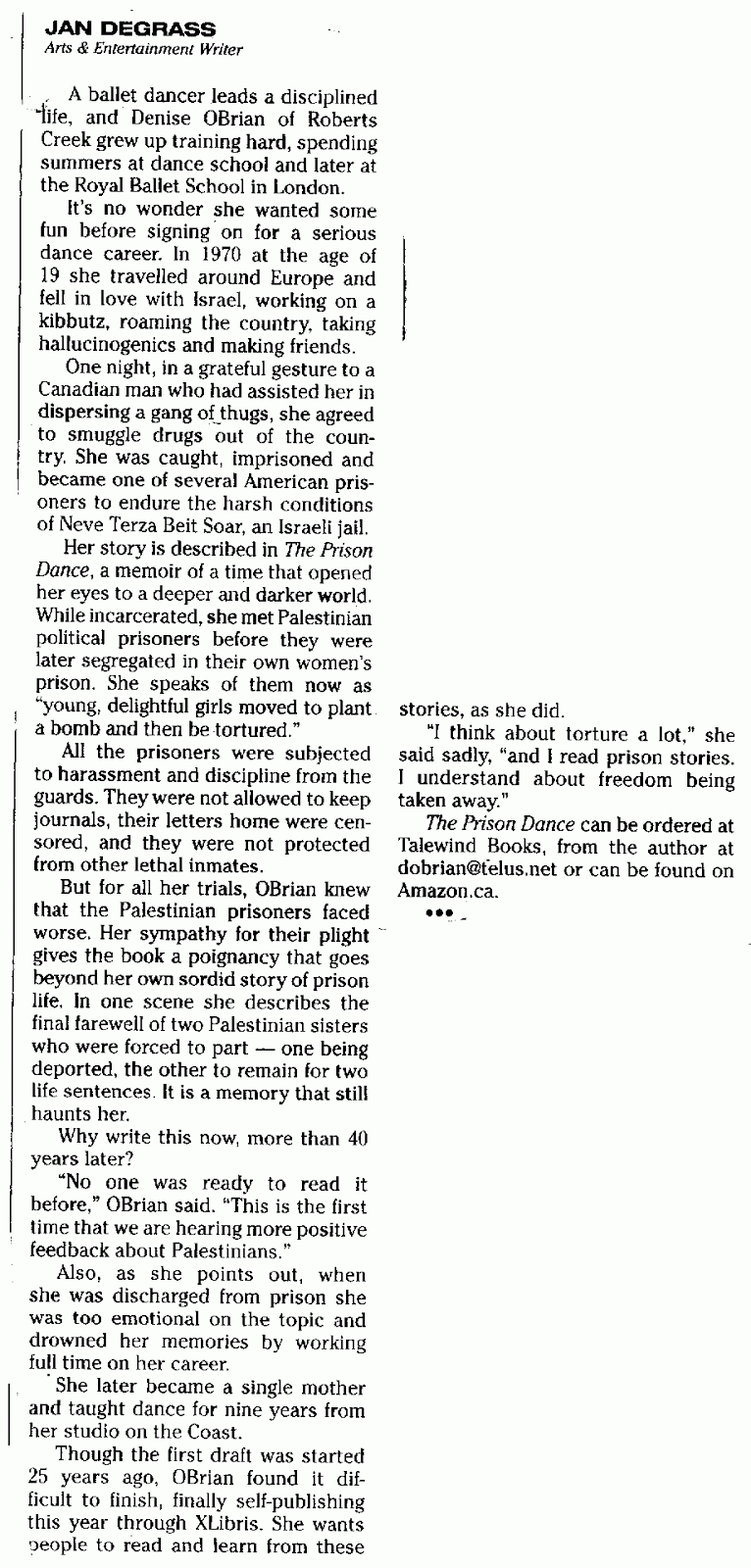
Guest Post: Author Jan Degrass

The Prison Dance is available on order from any bookstore through Ingrams and can be ordered in paperback or as an ebook from Amazon.com.  In addition, the book is listed in Ingram's data base as returnable until August 2014, an offer any bookseller can take advantage of in tat time period. For further information go to the website  www.theprisondance.com

How did you become an author?
I became an author because I had promised Palestinian women political prisoners, many years ago, that I would tell their story. I also had to write about my experiences as a way to attempt to understand what I had personally been through. Not least, I had to write because creative expression has always been as necessary to me as breath.

What was your first published piece?
My memoir The Prison Dance is my first published piece.


(please click on images to embolden)

Where was it published?-How long ago?
It was published with Xlibris a year ago.  

What did you do before embarking on your writing career? Was it an asset to your writing? How?
Before writing, I was a contemporary ballet dancer, touring and performing internationally. When I began to write I was still teaching dance and choreographing. The creative process was ingrained in me and this was extremely useful when I set out to write.

What inspires you?
Tales of hardships endured and the triumph of the human spirit inspire me. I read a great deal and am constantly in awe and grateful to authors who can translate their life experiences with deftly chosen words. Although I read a lot of fiction, I especially love memoirs of adventure travel and exploration, prison survival experiences, altruistic aid and activism, and lifetime goals achieved through self-sacrifice and innovative or even synchronistic means.

Please share one of your successful author platform building technique
I am nothing if not tenacious. It took me a very long time to write the book as I came up against a great many obstacles but I believed in what I was trying to say and kept at it. Now that the book is published and I have received enthusiastic and positive feedback I know that all the gruelling work was worth it to make the connections I have thus far.

Parting words
I hope as many people as possible will read The Prison Dance because I feel Palestinian freedom is central to the maintenance of worldwide peace in our time and that this memoir is more accessible than many books written regarding the Palestinian question. That is to say, the book includes stories of my own exploits and tales of an era (the end of the sixties) which, in retrospect, seem rather humorous. Because of this, many readers have told me that despite the profound nature of the book they found  The Prison Dance entertaining and intriguing as well as informative.


(Please click on article to embolden the text)

Friday, May 17, 2013

Why Mysteries? by Phyllis Smallman


One of the questions I’m always asked is, “Why do you write mysteries?”

First of all, I love to read mysteries. Mysteries are epic adventures, life and death struggles to right wrongs, to see justice done and to discover truth.  Often reluctant and unprepared, the hero or heroine goes on a quest, taking us with them.

Stories of crime explore the darker side of human nature, greed, anger; jealousy and love…all of these emotions are at the heart of a good mystery. We all fear being the victim of crime. Each of us feels as vulnerable to crime as we do to disease.  Money won’t protect you …nor does education…nor culture…and while we already know how dangerous the world is without mysteries to tell us, our fear holds us enthralled. 

As I grow older a phrase comes back to me…. “things are going to hell in a handcart.”  From the bible to Starwars, the fight against evil goes on.  In fact the first crime stories appear in the bible…Cain murdering Able...Joseph being sold into slavery…the bible is full of tales of theft and murder, tales of the killing of babies.  And you think identity theft is new?   Think of Jacob stealing Esau’s birthright.  These stories tell us things are not getting worse, they were always like this and for me this is a comforting thought. We may not be winning but we’re not losing either. It is a struggle that goes on day after day and generation after generation.

Crime is so central to life we name it like the Eskimos name snow. Petty crime, blue collar crime, or major crime, I write about it because I write about the drama of life.

Phyllis Smallman
www.wphyllismallman.com

This article was first published on OmniMystery News on February 5th, 2013. It's re-printed here by permission of the author.


Phyllis Smallman is the award winning author of 5 books in the Sherri Travis mystery series, chosen by Good Morning America as one of the 6 best mystery series for summer reading in 2010.  Her next book, Long Gone Man out in the fall of 2013, and is the first in a new series.


Friday, February 15, 2013

Guest Post: Author Andrew Demcak


How/why did you start to write?

That’s a good question – I really can’t remember not writing.  From my early banging on my mother’s typewriter to my first crayons; I think I was always trying to write if not actually writing.  I used to make up poems and stories all the time in elementary school, too.

How did you become an author?

When I was eighteen I was obsessed with getting published in a literary journal called Pearl Magazine (Anais Nin started it in the 1970’s) but they wouldn’t print one single adjective I’d committed to paper.  I feel like I became an author when, three years later, they published my poem, Waiting for Noah.

What was your first published piece?

My first prose piece was a mock-ponographic story called Meat Man – I’ll let you imagine what it was about – Let’s just say veal cutlets were involved and it was very funny.

Where was it published?

Genre (the Comp Lit department’s journal at CA State Long Beach U.)  It was the most hotly contested story in the magazine.

How long ago?

Twenty-six years ago.

What did you do before embarking on your writing career? Was it an asset to your writing? How?

I’ve always worked in libraries, as a clerk, or assistant – I got my Masters degree and now am a librarian professionally.  It certainly helped being around books and people who love reading.

What inspires you?

Kindness.

Please share one of your successful author platform building techniques:

Friend everyone on Facebook, Google+, LinkedIn, Twitter, LibraryThing, Goodreads, etc.  Bug them constantly when you have work coming out.

Parting words

Your audience already exists:  you need to get your work out there so they can find you. Submit, submit, submit!


 Blurb:

"If There's A Heaven Above" takes the reader on a tour of the Southern California demi-monde goth scene of the mid-1980s, as seen through the eyes of club-kid, Matt. Andrew Demcak combines innocence with experience, sex and drugs, Love and Rockets, with just the right touch of poetry. It is a thrilling ride along the freeways and turntables of that era: when AIDS was new, Reagan was King, and hope was a wounded kitten, cared for by the creatures of the night. - Eric Norris, author of Nocturnal Omissions: A Tale of Two Poets (Sibling Rivalry Press)

Links:

Author website 


Poets & Writers profile 

Friday, December 14, 2012

Guest Post: Author Joan Boswell


Creative writing began for me when I volunteered to keep organizational minutes and discovered that I had to creatively fill in the gaps when my attention left the room for long periods. A friend, a member of a mystery writers’ critiquing group, suggested I should join them and also become a member of Capital Crime Writers. I can’t emphasize how important the critiquing group was to me. Without their carefully considered comments and encouragement I would not have grown as a writer.

The critiquing group morphed into the Ladies’ Killing Circle, six women eventually responsible for editing seven collections of Canadian women’s mystery short stories.
This past summer at Scene of the Crime on Wolfe Island, the Ladies’ Killing Circle received the Derrick Murdock award honouring their contribution to Canadian women’s mystery writing. My first published story, ‘One Cold Cookie’, appeared in 1995 in the first volume, The Ladies’ Killing Circle.

Later I co-edited the last four anthologies. Reading submissions provided excellent training in recognizing good writing and pin pointing why some stories didn’t make the cut. Applying this to my own writing was very helpful. I also had short stories published in each anthology and in many other magazines and anthologies. In 2000 I won the $10,000 Toronto Star Short Story prize. This story in on my web site Joanboswell.ca

As our group matured as writers some of us tried our hand at novels. My first, Cut Off His Tale, was published in 2005 by Napoleon RendezVous as were the next two, Cut to the Quick and Cut tothe Chase. The fourth book in the series, Cut to the Bone, is published by Dundurn.

I spent many years in university earning a BA, MA and PhD before returning and completing the course work for a Fine Arts Degree. I have had more than 10 solo shows and continue to paint and to work with textiles although for the last few years writing has taken more of my time.

For a few years I worked for the Department of Indian and Northern Affairs as a researcher but once I returned to university to study fine arts I focussed on being creative.

I am a very visually oriented person and I see the scenes in my stories and books before I write them. In each of my books I deal with different social issues. In the most recent book the plight of Aboriginal women and their marginalization concerns me. Mysteries give me the opportunity to deal with social issues while always trying to entertain.


Cut to the Bone


It’s happened again! Hollis Grant, who has fashioned a new life for herself with a foster child, a puppy and a job as resident super of an eight story apartment building finds herself in the middle of a murder investigation when a fifth floor tenant, a woman working for an escort agency is murdered.  The detective in charge is Rhona Simpson a police officer with whom Hollis has crossed swords in the past. Hollis’s life is further complicated by the disappearance of an Aboriginal tenant who leaves her young niece behind and a message asking Hollis to care for her. Her search for the woman places her in grave danger. Meanwhile a woman’s body dumped in Lake Ontario leads back to the apartment building. Hollis narrowly escapes being the third victim and her quick thinking leads to a surprising solution to the case.


Friday, August 31, 2012

Will You Be My Guest

Update:  Due to the demands of my writing life, I've been forced to discontinue publishing guest posts. However, you can still read the guest posts I have published by clicking this link I look forward to connecting with you on Twitter (lustful graces), Facebook and LinkedIn (author leanne dyck), and through this blog.

Since I created this blog on December 28, 2010 I've hosted authors on -Guest Post Friday. I continue to be delighted by how generous my guests are. Authors have shared their journey--and through their words I've gained inspiration and encouragement. 

Thank you for your interest in being a guest on my blog.

Questions...
How/why did you start to write?
How did you become an author?
Reflect on your writing process...
What did you do before embarking on your writing career? Was it an asset to your writing? How?
What inspires you?
Please share one of your successful marketing techniques
Parting words

These questions are only meant for inspiration. You are welcome to add, delete, or modify the questions as it suits your needs. You are, of course, welcome to write a guest post instead.

Please send your post along with...
Author links (website, twitter, facebook, etc.)
Book info (book cover jpg, blurb, buy links, etc.)
Author photo

Guests posts are featured on a first-come, first serve basis.  

Friday, August 10, 2012

Guest Post Author Terri Giuliano Long


Talent: Have It Your Way
I once read that within five years of completing their degree only ten percent of MFA grads are still writing. I may be wrong—I’ve never conducted a study—but if I were to guess, I’d say most of those writers gave up because somehow, battered by poor sales, a harsh inner editor or snide remarks from others, they concluded that they had no talent.
MFA grads are by no means the only writers who experience these jags. I’ve lost count of the gifted authors who’ve wondered aloud about whether they had talent, their confidence pummeled by rejection, poor sales, a bad review. I’ve struggled with the question myself.
Talent is a slippery, indefinable thing. If we can’t define it, how do we know what it is?
What is talent, anyway?
The problem is, the definition is subjective and depends largely on values and taste. To some, talent means that an author writes lyrically or wins literary prizes. For others, it’s all about taut plotting or monster book sales. Even these definitions are vague. Which prize must an author win? An online contest? The Pen/Hemingway Award? The Pulitzer? How many books must an author sell? 10,000? 100,000? 1 million? 50 million?
Stephen King defines talent this way: “you wrote something for which someone sent you a check . . . you cashed the check and it didn't bounce . . . you then paid the light bill with the money.” Considering that a light bill can be as low as $10, I applaud his generosity.
But what does King’s monetary criteria say about a writer like John Kennedy Toole, author of the posthumously published masterpiece A Confederacy of Dunces?
The editors at Simon and Schuster admired Toole’s writing, yet ultimately rejected his novel, because, as one of them put it: “your book isn’t really about anything.” In 1969, after several failed attempts to revise his unpublished book, Toole committed suicide.
If we can’t define talent, how do we know if we have it?
If publishing success equals talent, then Toole, who couldn’t find a publisher for his novel, had no talent—at least not in his lifetime.
But wait—
After Toole’s death, his mom passed the manuscript to the novelist Walker Percy, who shepherded the novel through publication. In 1981, A Confederacy of Dunces won the Pulitzer Prize. The book has sold 2 million copies and been translated into 18 languages.
So Toole had—what?— posthumous talent? This anecdote might be humorous, if not for the fact that so many writers buy into this or other equally spurious definitions of talent.
Who but artists are judged on the basis of whimsy or taste? No wonder we’re insecure.
One Percent Inspiration, Ninety-nine Percent Perspiration
Thomas Edison said: genius (talent) is one percent inspiration—ninety-nine percent perspiration.
Not all of us are inspired, surely not always. And genius, it’s commonly assumed, is a birthright, beyond our control. Perspiration, on the other hand, we control. Equating talent—or genius—with hard work motivates me; it puts me in charge of my future.
One of my grad school professors told this story: the admissions committee, having reviewed the application of one candidate, was about to reject her. The woman, they felt, had no talent. Surely, she would fail. Maybe because there were not enough candidates that year, they gave her admission.
This woman, this no-talent writer, wanted success, and she wanted it badly. For three years, she busted her butt. And what happened? She emerged as the finest writer in the program.
“If you have energy but no talent, you can still be a prince.” Jeffrey Archer
Natural ability—deep insight, a facility with language—may shoot a determined, hard-working writer into the stratosphere. But even a brilliant writer, if lazy, is doomed to fail.
Next time the demons arise, remember this advice from bestselling author Jeffrey Archer:
“Never be frightened by those you assume have more talent than you do, because in the end energy will prevail. My formula is: energy plus talent and you are a king; energy and no talent and you are still a prince; talent and no energy and you are a pauper.”
We may never reach the heights of Stephen King, John Kennedy Toole or Jeffrey Archer. We may not want to, either. If talent is subjective, and I believe it is, then we can define it on our own terms. No reason to accept or internalize the beliefs or criticism of others. They’re often wrong anyway. The critics panned James Joyce’s masterwork, Finnegan’s Wake. Today, it’s considered a giant in the literary cannon. Yes, critics are often wrong.
This, to me, is tremendously freeing. I’ll stick with Edison’s vision of talent. Inspiration may come. But I’m not holding my breath. I’d much rather roll up my sleeves and dig in!
How do you define talent?

About Terri
Terri Giuliano Long has written news and features for numerous publications, including the Boston Globe and the Huffington Post. She lives with her family on the East Coast and teaches at Boston College. Her debut novel, In Leah’s Wake, began as her master’s thesis. 


About In Leah’s Wake
A Story of Love, Loss, Connection, and Grace

The Tylers have a perfect life—beautiful home, established careers, two sweet and talented daughters. Their eldest daughter, Leah, is on track for a prestigious scholarship. Their youngest, Justine, more responsible than seems possible for her 12 years, just wants her sister's approval. With Leah nearing the end of high school and Justine a seemingly together kid, the parents are set to enjoy a peaceful life...until Leah meets Todd, a high school dropout and former roadie for a rock band.

As Leah's parents fight to save their daughter from a world of drugs, sex, and wild parties, their divided approach drives their daughter out of their home and a wedge into their marriage. Meanwhile, twelve-year-old Justine observes her sister's rebellion from the shadows of their fragmented family—leaving her to question whether anyone loves her and if God even knows she exists.

Can this family survive in Leah's wake? What happens when love just isn't enough?

***
Margot Livesey, award-winning author of The Flight of Gemma Hardy, calls In Leah's Wake, "A beautifully written and absorbing novel."

CTRR Reviewer Recommend Award
Book Bundlz 2011 Book Pick
Book Bundlz 2011 Favorites - First Place
Reviewer-nominated for Global eBook Award, 2012
Named Top-Title, IndieReader Discovery Awards, 2012

Praise for In Leah’s Wake
 “In Leah’s Wake is an astounding story of a family in transition.”
--Tracy Riva, Midwest Reviews
 “Pulled me right along as I continued to make comparisons to my own life.”
--Jennifer Donovan, 5 Minutes for Books, Top 50 Book Blog
“Multiple ripples of meaning contribute to the overall intensity of this deeply moving psychological drama.”
--Cynthia Harrison, author of Sister Issues
"Sometimes scary, sometimes sad, and always tender."
-- Susan Straight, National Book Award finalist, author of Take One Candle Light A Room