Showing posts with label hand knitting patterns. Show all posts

Friday, November 9, 2012

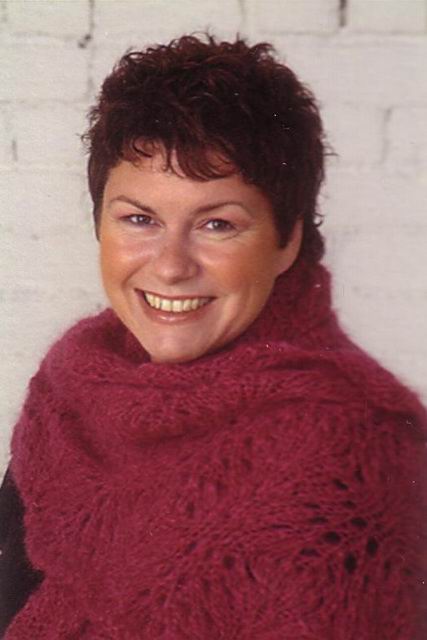
Guest Post: Knitwear Designer and Author Fiona Ellis


Who taught you to knit?  I learned to knit at about 5 years old, being taught by my grandmother. I loved to experiment, consequently my dolls were the best dressed in the neighborhood, even if some of them were doomed to be fashion victims or ridiculed for their daring outfits.


What knitting method do you use? Continental? English? Or...? I grew up in England and I was in my 20's before I even knew there was another way to knit . I still knit English style.


What is your favourite stitch pattern? My favorite type of patterning is cables.


Why do you enjoy working Fair Isle knits? Yes I LOVE working with colour and dreaming up different colour stories.


What is your favourite yarn? I love good classic smooth wool yarns or a blend that is predominately wool. At the moment I'm loving working with tone on tone hand painted yarns - I have just just worked with both Sweet Georgia Yarns and Tanis Fiber Arts Yarns and I love them!


Is there a needle size that you prefer? Bamboo, plastic or steel needles? I like the 4- 4.5 mm range best and I still use my original Aero needles from the set I was given for my 14th birthday. But I am rather partial to my Signature needles too.


What is your favourite item to knit? I make mostly sweaters for women so I guess that's my favourite.


Where is your favourite place to knit? I knit just about anywhere so I don't really have a favourite.


What are you currently working on? I'm working on some new cable designs and swatches for my Craftsy classes.


Why did you become a knitwear designer? I have always loved fashion and so that is what I chose to study at University I went as a "mature" student at age 28. I graduated from DeMontfort University with a degree in Fashion Knitwear design. It is one of the few school that offer an intensive teaching solely in fashion knitwear at a degree level.


Tell me about your first pattern.
Where did it appear--on your website, in a magazine or ezine? When I was first designing I sold my original designs concepts to the major fashion houses in New York, London & Paris who would put them into mass-market production. I sold my first design for the hand-knit market to Vogue Knitting for the Winter 1999 issue.
 
Do you attend fibre festivals? Why? Why not? Which ones? I don't really go to fiber festivals unless I'm teaching there.

Have you taught knitting classes? Where? When? Oh gosh yes I have been teaching all over North America since 1998. I have developed a unique program of lively and interactive workshops for knitters and textile artists, where I approach my teaching from a personal development and creativity standpoint, rather than being simply technique based.


What is the most rewarding aspect about being a knitwear designer? I love seeing what knitters do with my patterns, when they make it their own, use my idea as a springboard for their own creativity.

Challenging? Finding enough hours in the day to work on all the ideas that I have.
Books

'Contains 20 patterns for contemporary cable sweaters & accessories'


'Borrowing from tradition Fiona delivers a superb collection of gorgeous, wearable garments divided'


Friday, October 19, 2012

Guest Post: knitwear designer Jill Wolcott


I am a hand knitwear designer.  Unlike most hand knit designers, I didn’t come to this because of my love of knitting.  In fact, I re-discovered hand knitting after I began to do machine knitting which I came to as a fashion designer! 


I learned to hand knit as a tagalong with my older sister’s Brownie troop to lessons at the local yarn shop in Olympia, Washington.  I was 6 years old and loathed everything about it.  We learned the English method and I would happily have abandoned my project if my mother hadn’t made me finish it.


My mother was a knitter and I always think of her sitting in a chair in the living room with her feet on an ottoman, the New Yorker on her knees and her knitting needles clicking.  She knit primarily stockinette (probably to aid with reading progress).  We were thrilled when she learned Seed Stitch and we got something other than rib trim on our cardigans.  She is what I call a flicker—she flicks her yarn with her right forefinger.  I leaned to Continental Knit in 1995.  I wrote a Continental knitting instructional book with my former business partner in 2006 for which I did 96 illustrations.


I knitted the odd piece in the years intervening being 6 and 1993 when I started submitting machine knit designs to magazines. I had turned to machine knitting after moving to a new city where there were no jobs for my design skills.  I figured people always needed sweaters!  When I began learning how to use the knitting machine I disliked almost everything being created by machine knitters.  I pulled out old Vogue Knitting magazines (I had always kept a subscription to that even though I didn’t really knit) and figured out how to accomplish things I liked using my hand knitting knowledge (and occasionally calling my mother) on the knitting machine.


In 1994 before leaving for a vacation I picked up yarn from the sale bin of a local yarn shop because I didn’t feel I could stand to be away from knitting for two weeks.  I really enjoyed the portability of hand knitting and had a great time designing and knitting a sweater.  That sweater was an intarsia patchwork of different stitch patterns in three colors, put together in a planned random pattern.  I was hooked on hand knitting.

I started to do hand knit design as well as machine knits.  I like almost every type of stitch pattern, although I am not inclined to do much stranded knitting.  I love vintage lace patterns, and often find myself dissecting patterns to find their hidden elements.  Mostly though I am pursuing an idea, so I find stitch patterns that suit the concept.


The first knitting pattern I wrote was for a coat for a friend’s toddler daughter.  I wrote a variation of that design for a pattern that I sold to Machine Knitting News.  I think my first hand knit pattern was for Knitters.  I had a terrible time learning how to write effective patterns.  What magazines publish didn’t really seem clear to me; I think I struggled for about five years before I realized that I just saw things differently.  I call myself “directionally dyslexic”.  I have a hard time with right and left, and right side and wrong side conversions.  I do shaping for both sides in my patterns, and am pretty meticulous about tracking right and wrong sides.  I don’t have to be as concerned about how much space I use.  I also do my charts to reflect the stitches on the side you are looking at because I can’t do the mental transition.  Really, I’m not as dumb as this makes me sound! 

I have my own pattern line which allows me to write in a style that is clearer to how my brain functions. I have about 50 patterns currently available on my website, and at least that many more available on Ravelry in an old format while waiting for transition to my new format.  I always have about two dozen projects in the works.  Unlike many hand knit designers, I don’t knit my samples.  I write the patterns from swatches and they are knit (almost always just once!) from my instructions.

Knitwear design is rewarding because I get to create both shape and fabric.  I never cease having more ideas than I could possibly pursue, and every day I love sitting down to knit swatches.  The challenge is that knitwear design is not valued within the hand knitting community and it is extremely difficult to make money at it. 

At heart I am a fashion designer.  I love and follow fashion,  and I try to translate what I see in fashion for people who knit.  I look at all types of garments and translate elements and shapes into my designs.  I want to design things that, for the most part, will be fashionable in three years if that’s how long you take to knit it.  I create contemporary fashion, not fast fashion.  I am inspired by yarn, and stitch patterns, but almost always it comes back to fashion and style for me.


My advice to knitters is to enjoy the process.  It be just about the knit product, you should allow yourself to experience the pleasure of all that yarn running through your fingers, how you feel about your accomplishments, learning new things, and seeing what transpires as you manipulate your yarn and needles.  In the end, if you had to knit the same ball of yarn over and over, it could still be a pleasure (well, for a while).  We get too focused on the price of the materials we are using and how long it takes and we forget how much we get out of it.  Not only do we create things, we entertain ourselves, sooth ourselves, and help us get through things we’d just rather not (kid’s sports, waiting rooms, family visits, you name it!).


The most important things I am working on right now are books. I am focusing on redoing the Continental knitting method book.  I am changing the voice and the focus.  I want to provide how-to-knit instruction, and also give guidance through many of the things needed to transition from scarves to creating garments or more complex projects.  After that I have about five books to write!


I am a solo business owner for the first time in over 10 years.  This has proved to be more enjoyable than I thought it would be, although it is also scary and unnerving sometimes.

To view more of Jill's lovely designs, please log on to www.jillwolcottknits.com


Monday, February 20, 2012

Ending your career in knitwear design by Leanne Dyck

(photo from Google images)

In January 2011, I had over twenty designs in my collections and my knitting needles were loaded with stitches. In fact, the only thing that had changed was that, with the publication of The Sweater Curse, I had become an ebook publishing house author.

So, why did I close my knitwear design business?

I can answer this with one word—focus. I was determined to focus on building my writing career.

Back in October 2010, I had made a pact—with myself—to submit one story every month. That strategy had helped me place The Sweater Curse. While I was scaling this mountain I continued to work on my knitwear design career. Serving two masters was exhausting physically, mentally, and emotionally.

The decision to close my business wasn’t easy. I couldn’t shake the feeling that I had failed. It’s silly what junk a self-conscious can feed you. However, whether or not I bought into this falsehood was up to me and—after giving my head a shake—I decided that I couldn’t afford to.

I didn’t fail, I told myself. I’ve evolved. I’ve grown from a knitwear designer who writes to an author who knits.

I’ve benefited from my years as a knitwear designer. I've amassed a fortune. These riches include...
-a supportive community
-knowledge about the field
-a popular website which has evolved with me
-ten years of knitting-themed writing

I hope you will travel with me as I continue to evolve.

Monday, February 13, 2012

Establishing your career in knitwear design by Leanne Dyck


Congratulations you've reached the middle of your career.

By this time...

1. You've built or are building a website, blog, and social network
(By social network, I mean a twitter id and Facebook community, etc.)

2. You are doing at least one thing every single day to promote your business

3. You wear your own designs
Wearing your designs is important for three reasons
a)it's a good way to market your designs
b)it helps you find designs flaws
c)it helps you envision new design directions

4. You always carry a business card and distribute it freely. 

5. You sell online
a)over your own website
b)a third party website (i.e. Etsy)
c)Your patterns are featured on knitting ezines (i.e. Knitty)
6. You've made connections with the editors of in print knitting magazines (i.e. A Needle Pulling Thread, etc.)

7. You have a three-prong approach to your business
a)you sell knitting patterns
b)you conduct workshops
c)you sell your knitting through galleries

8. You're mentoring with a knitwear designer you meet at a workshop

9. You're assisting a local wool producer by developing designs with her wool

10. You're continuing to build your community of support

11. You do a monthly assessment of your business to determine what's working and what isn't. (By working I mean you enjoy it and it makes you money.) After your assessment, you make necessary adjustments to your business plan.


Monday, February 6, 2012

Beginning a career in knitwear design by Leanne Dyck


Recently, I led a discussion regarding The Beginning, Middle and End of a career in Knitwear Design.
 

Where did I acquire my knowledge on this topic?

My career in knitwear design began in August 2002 and concluded in January 2011. During this time, I was a member of the Knitwear Designer Association and the Canadian Knitwear Designers and Artisans. My collection consists of 25 designs, and I have sold patterns to knitters in Canada, the USA, the UK, Japan, Israel, and Australia.. My designs have been featured in the magazines A Needle Pulling Thread and Knit Together, as well as in knitting calendars published by Accord Publishing.

Some tips for beginning a career in knitwear design

think of yourself as an apprentice
-learn as much as you can about the craft from a variety of sources
 online
workshops
one-on-one from other knitters/knitwear designers/yarn producers
-develop a system for recording and collecting your design ideas
-gleam inspiration from a variety of needlecrafts
-assemble resources (books, websites)

as you attend workshops
 -network with knitters/knitwear designers/yarn producers/magazine publishers
-have a 'community building' or win-win mindset
-take note of the most popular workshops
file this information away for the future when you will be offering your own workshops

When you begin to write your patterns seek the assistance of knitters. They are invaluable resources to proofread your patterns.